

William (Bill) Sikkens
I have been a part of the information technology industry all of my life. During my time, I have owned and operated my own business as well as worked for several notable companies, including Wells Fargo Bank and Intel.
Also during this time, we have faced many challenges in the industry.
Technology evolves very quickly. When I started, we were using second and third-generation computers (486/Pentium/Mac Classic), and a 17” CRT monitor was a big deal. There were no smartphones, high definition television, or streaming. The World Wide Web was in its infancy.
In the early 1990s, if you wanted to order food, you would do that at a restaurant. Pizza and a few things could be delivered, which was convenient if you wanted to eat and watch the movie you rented from the local video store.
If you wanted to call someone, you would pick up a phone at home and dial a number. If you had an advanced enough phone, it might be cordless – pull out the antenna and walk around. Don’t get too far away from the base station, though; your call will become static. Calls from outside the house? Find a payphone.
This thing called a cell phone existed. If you had money and needed one, you might get one – but be prepared to pay for it. At around fifty cents a minute plus a $90 monthly access fee (approx. $1.15 per minute and $212 per month adjusted for inflation) you would watch every minute of use. You could get a cell plan that would include 30 minutes of use per month, but that costs more.
Fast forward to 2025, and the world has changed. You want food delivered – hit a website, Grubhub will bring whatever you want. It might even be delivered in a jetsuit. (Google “jetsuit pizza delivery” to check it out). The latest movie? Hit your favorite streaming service and watch it right now. Need to communicate with someone? Text them. And if you do need to talk, you can, with both audio and video.
We have faced many challenges in the industry. I would argue that today, the challenge is finding qualified people who understand tech.
To that end, I make an appeal for STEM Education and will be sharing ways in coming weeks on how I’m supporting this needed cause.
Here’s Why:
In today’s rapidly evolving economy, one fact stands out: STEM skills aren’t just “nice to have” — they’re foundational.
Consider these facts:
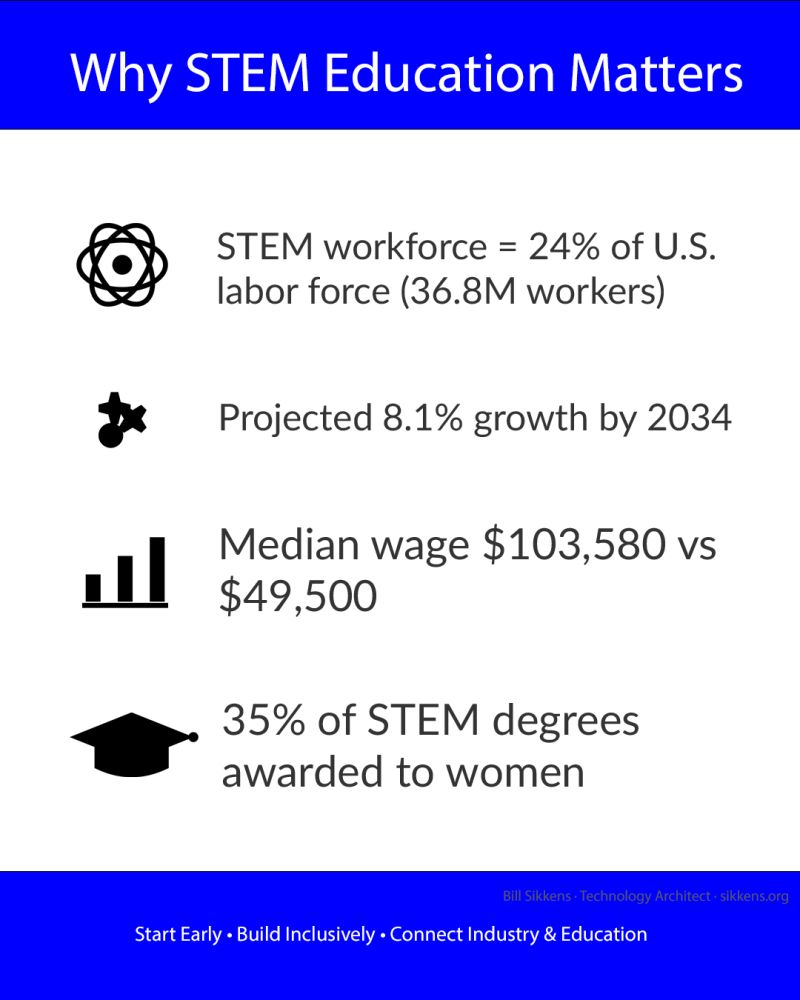
The STEM workforce already accounts for nearly a quarter of the U.S. labor force (~36.8 million workers), and it’s growing.
STEM employment is projected to grow ~8% by 2034, more than double the rate of all occupations, with median wages over $100 K/year in 2024.
Join me in supporting the next generation so they aren’t just ready for the future — they’re shaping it. 🚀